








Broadcast

DanGer Shock RCT: A Decade of Data

Andreas Goetzenich, Jacob E Møller, Christian Schulze , et al

Watch time: 1h 1m 37s

Broadcast

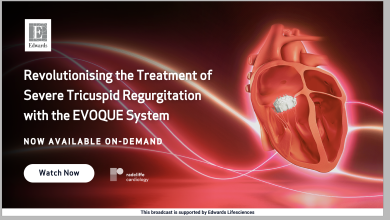
Evidence-Based Criteria for Transcatheter Tricuspid Valve Replacement

Volker Rudolph, Sam Dawkins, Ali Vazir, et al

Watch time: 1h 1m 24s

Broadcast

Evolving Strategies in Pulmonary Embolism: From Risk Stratification to…

Stavros Konstantinides, Sylwia Sławek-Szmyt, José M Montero-Cabezas, et al

Watch time: 1h 8m 28s

Broadcast

TAVI in Small Aortic Anatomy: Optimising Planning and Outcomes

Yohei Ohno, Andrew Cook, Mehdi Eskandari, et al

Watch time: 1h 16m 40s

Michael J Mack

Watch time: 2h 44m 15s (17 videos)

About

Transcatheter therapy of structural heart disease is advancing rapidly. Due to the less invasive approach, transcatheter techniques have replaced surgery as the standard procedure for atrial septal defect and patent foramen ovale closure.

Evolving interventional techniques allow treatment of paravalvular leaks, ventricular septal defects and valve replacement, especially the rapid evolution and newer indications for transcatheter aortic valve replacement (TAVR).
Articles

The Impact of Contrast-enhanced Echocardiography to Improve Agreement on Assessment of Left Ventricular Function

Citation:

Interventional Cardiology 2007;2(1):13-4

Stenting of Hypoplastic Aortic Segments with Mild Pressure Gradients and Arterial Hypertension

Citation:

Interventional Cardiology 2007;2(1):64-5

Safety Aspects in Carotid Artery Stenting - Is Flow Reversal the Solution?

Citation:

Interventional Cardiology 2007;2(1):42-4

Rheolytic Thrombectomy and Stenting for the Treatment of Acute Myocardial Infarction

Citation:

Interventional Cardiology 2006;1(1):12-3